
Ottawa Homeowner’s $135K Renovation Destroyed by Flood; Insurance May Pay Nothing
Two Ottawa homeowners thought their insurance would protect them after a major flood. Instead, they discovered that the most dangerous part of home insurance may not be the premium, but the fine print that appears only when disaster happens.
Many Canadian homeowners pay high home insurance premiums every year because they believe that if a fire, flood, or major accident damages their home, insurance will at least help them get through the most difficult stage.
But the experiences of two Ottawa homeowners show that the most troubling part of insurance is often not how expensive the premium is. It is that after paying for years, consumers may discover only after a disaster that the risk they thought was protected may not be covered at all.
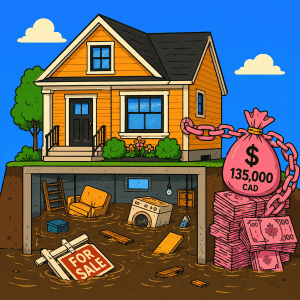
One homeowner borrowed more than $135,000 to renovate her home. She was only weeks away from listing it for sale when a severe Canada Day storm caused sewage to flood her basement. She had been insured with the same company for more than 20 years, yet weeks after the disaster, she still did not have a full estimate or clear payment timeline. She worried that within a few months she might have no choice but to file for bankruptcy.
Another 71-year-old homeowner believed she had purchased the highest level of flood protection available to her. After her basement flooded, however, her insurer denied the claim, saying the water was groundwater infiltration and was not covered.
A Once-in-a-Century Storm Turned an Ottawa Street into a River
When the Canada Day storm hit Ottawa’s Bells Corners community, Oberon Street, where Kathryn Peterkin lives, was quickly overwhelmed by water. The street nearly turned into a river.
At first, Peterkin even took the opportunity to launch a kayak and paddle through the flooded road. But that brief moment of novelty quickly turned into a long-running life and financial crisis.
Sewage backed up through the drainage system into her laundry room and bathroom. Water mixed with waste and sewage filled the basement. Newly renovated flooring, walls, ceilings, bathroom work, and equipment were all damaged.
Nearly three weeks after the storm, Peterkin still did not feel safe living normally inside the home. Concerned about moisture and mold, she was temporarily living in her garage.
This disaster destroyed everything, completely. I live in fear every day.
For others, this may sound like a home flood claim waiting to be processed. For Peterkin, each day of delay means another day of loans, interest, and carrying costs.
She Borrowed $135,000 to Renovate and Was Weeks Away from Selling
A few months before the storm, Peterkin had borrowed more than $135,000 to complete a major renovation of the home.
Her plan was straightforward: renovate the property, increase its value, list it for sale as soon as the work was finished, and use the sale proceeds to repay the loan.
Before renovations began in November, a real estate agent estimated the home at about $400,000. By the following March, after the renovations were largely complete, the agent believed the home could sell for close to $600,000.
To complete the work, Peterkin and contractors worked for more than six months. The basement was renovated, the bathroom rebuilt, and the floors and ceilings replaced.
Then, with only a few weeks left before the home was expected to be listed, the storm arrived.
The renovations that were supposed to increase the home’s value were largely destroyed by sewage. The home could no longer be listed as planned, the renovation loan still had to be paid, and a second round of cleanup and repairs could now be required.
I had everything planned. All the loan money went into the renovation, and once the house sold, I would pay everything off. Now the whole house is ruined.
After 20 Years of Insurance, Her First Major Claim Still Had No Clear Answer
Peterkin said she had been insured with Economical Insurance for more than 20 years and had never previously filed a home insurance claim.
But when she finally faced a major disaster, she could not get clear information about the claim.
She said that nearly three weeks after the storm, the insurer still had not provided a formal, complete estimate. Without that estimate, she did not know which repairs had been approved, how much she would have to pay herself, or whether she could safely start full repairs.
What she needed most was a clear answer: how much the insurer would pay, and when.
Instead, she kept waiting.
I can’t keep paying the loan. In another two or three months, I may have to file for bankruptcy.
Peterkin also said that after repeatedly asking for updates, the insurer asked her not to keep sending frequent messages.
Definity Financial Corporation, the parent company of Economical Insurance, said the company had remained in contact with Peterkin, completed a site inspection, and approved replacement of key equipment such as the furnace and water heater.
The company said Peterkin reported the claim on July 3, staff first contacted her on July 4, an inspection was arranged for July 7, and the site review was completed on July 8. The claim, according to the company, remained under active review.
But for Peterkin, whether the insurer was “following up” was not the main issue. She still did not have a complete estimate, a clear repair timeline, or an answer on how much of the damage would ultimately be covered.
After media contacted the insurer, she was told a new adjuster would take over the file. Still, no concrete timeline or final payment result was provided.
The Insurer Says It Is Processing the Claim, but the Homeowner May Run Out of Time
Anne Marie Thomas, director of consumer and industry relations at the Insurance Bureau of Canada, said claims of this kind typically take about one month to six weeks.
Because the Canada Day storm affected about 6,000 people, many claims were submitted at the same time. Adjusters and disaster restoration companies had limited capacity, so waiting times could become even longer.
From the insurance industry’s perspective, this may look like a backlog caused by a large-scale disaster.
For a homeowner, however, a delayed insurance claim is not an abstract administrative issue.
Peterkin still has to make loan payments. The home cannot currently be sold. The renovation work has been damaged. Sewage and mold concerns remain inside the property. Even if insurance eventually pays, a process that drags on for months could leave her financially insolvent before the money arrives.
The insurance company has time to study the policy. The disaster-hit family may not have time to keep carrying the cost.
Government Disaster Assistance May Not Fill the Gap Either
In addition to uncertainty around the insurance claim, Peterkin’s home may also be ineligible for Ontario’s Disaster Recovery Assistance for Ontarians program, known as DRAO.
The program is intended to help eligible residents, small businesses, farms, and non-profit organizations with some essential disaster losses that are not covered by insurance. But it only applies within areas designated by the provincial government and comes with limits based on location, disaster type, primary residence, and the nature of the loss.
Peterkin’s home mainly suffered from sewage backup. At the same time, Bells Corners was not included in the initially announced assistance area.
That means she may fall into two separate gaps: the insurance claim is unresolved, and government assistance may not apply.
Her friend, Mike Cross, said he found the situation difficult to understand. In his view, residents pay their taxes on time, and after a major disaster, the government should not help only some communities.
Several Ottawa communities have also called on the provincial government to expand the DRAO coverage area.
Ontario’s Ministry of Municipal Affairs and Housing said the assistance area was designated based on information provided by the City of Ottawa, and that the province would continue communicating with the city and affected residents.
But for homeowners who urgently need repairs and must keep paying loans, “continuing to communicate” is not the same as receiving actual compensation.
She Bought the Highest Flood Coverage, Yet the Claim Still Paid Nothing
Peterkin faced an unclear and delayed claim. Margaret Cooper, a 71-year-old resident of Ottawa’s Crystal Beach community, faced a direct denial.
Cooper said her bungalow had been in her family for more than 50 years. Even during severe rain in the past, the basement had never flooded.
Because the home was her most important asset, she tried to buy the broadest coverage available to her. She said she chose an upgraded home insurance policy that she understood to be the highest level of water damage protection, hoping the home would be protected in a major disaster.
But after the Canada Day storm flooded her basement, the adjuster for belairdirect told her the loss was caused by groundwater backup or groundwater infiltration, which was not covered under her upgraded water protection.
The adjuster told me he was very sorry, but because this was groundwater, they could not pay a cent.
Cooper said she had paid high premiums for years and had purchased what she believed was upgraded flood insurance. Only after the flood did she learn that the risk she needed most was excluded.
I feel like I was deceived.
Homeowners See a Flood. Insurers See Different Categories of Water
To ordinary homeowners, the basement is simply flooded.
To an insurer, however, the same flooded basement may be divided into several completely different categories, each with different policy terms.
Basic home insurance often covers water damage caused by internal household systems, such as burst pipes, leaking water heaters, refrigerator supply line failures, or washing machine problems.
If the water comes from outside the home, many policies require the consumer to purchase specific additional coverage.
Sewage or wastewater backing up through sewers, drains, or floor drains into the basement is usually treated as sewer backup.
Rainwater or outdoor water entering through doors, garages, window wells, or other surface-level openings is usually classified as overland flood.
When soil absorbs heavy rain and groundwater pressure rises, water that enters through foundation cracks, basement floors, or walls may be classified as groundwater infiltration.
For homeowners, these situations lead to almost the same outcome: the basement floods, finishes are destroyed, furniture is damaged, and the home needs repairs.
For an insurer, however, whether the water came through a drain, a window, or a foundation crack may determine whether the claim is worth tens of thousands of dollars or zero.
Consumers may think they bought “flood insurance,” but at claim time, the insurer is not only asking whether the home was damaged by water. It is asking whether the loss fits a specific covered definition in the contract.
A Policy May Look Comprehensive, Yet Still Contain the One Exclusion That Matters
Cooper’s upgraded policy included coverage for sewer backup, overland flood, and exterior service line damage.
To an ordinary consumer, that may sound very close to comprehensive water protection.
But the policy excluded groundwater infiltration.
After inspecting the home, the insurer concluded that storm-related pressure had pushed water through visible foundation cracks, and that no evidence of sewer backup was found. The loss was therefore categorized as excluded groundwater damage.
Cooper said she did not receive a complete inspection report and was not given enough evidence to prove that all the water damage came from groundwater infiltration.
belairdirect said that because of privacy rules, it could not discuss individual claims publicly, but that adjusters review all facts and policy wording when assessing claims.
The most powerless part of this kind of dispute is that the insurer usually controls both the technical classification and the interpretation of the policy.
The homeowner may not have the ability to prove where the water entered and may not have the money to hire independent experts and lawyers to challenge the insurer’s conclusion. If the insurer places the loss into an excluded category, the consumer may have to bear the entire cost alone.
Surface Water and Groundwater May Be Almost Impossible to Separate
The public education organization Canada WaterPortal notes that distinguishing overland flooding from groundwater infiltration can be extremely difficult and sometimes impossible.
During an extreme storm, the ground surface, drainage system, and surrounding soil may all become saturated at the same time. Some water may enter through doors or windows, some may back up through drains, and some may seep through foundation cracks.
Yet the insurer often has to identify a primary cause.
That classification may decide whether the claim is accepted or denied.
In other words, after the same storm and the same flooded basement, a different classification by an adjuster could lead to a completely different claim result.
Consumers usually cannot know in advance which category a future flood will fall into. Even if they purchase multiple water damage endorsements, they may still be told after a disaster that the water came from the one direction not covered by the policy.
Insurance products sell peace of mind. Claims are decided by definitions.
“Comprehensive Coverage” May Be Marketing. Exclusions Are the Real Contract.
Insurance lawyer Kevin Butler has said that if insurers sell a product in a way that leads consumers to believe flood damage is covered, but then rely on exclusions buried in a lengthy policy to deny the claim, that could raise serious issues.
He noted that if the coverage consumers actually receive is materially different from what they believed they were buying based on the insurer’s presentation, the insurer may face legal responsibility.
The problem is that most consumers do not read dozens of pages of policy wording line by line, and they do not understand the legal distinctions among hydrostatic pressure, groundwater infiltration, overland water, and sewer backup.
Insurers may use simple names such as enhanced water protection, upgraded protection, or comprehensive water damage coverage in advertising and sales conversations.
But when disaster happens, the deciding language is not the marketing label. It is the definitions, exclusions, limits, and conditions buried inside the policy.
This does not mean every insurer or every denied claim is fraudulent. But it does describe a feeling many consumers may recognize: you believe you bought protection, and only when disaster happens do you discover that the most important risk was excluded.
The insurer sells the consumer a sense of safety. The consumer may still be left carrying the risk.
Homeowners May Need to Prove Not Just the Damage, but Where the Water Came From
In many insurance disputes, proving that the home was damaged is not the hardest part.
The harder part is proving that the loss matches a covered cause under the policy.
Water in the basement is not enough to prove the insurer must pay.
The homeowner may also need to prove:
- whether the water came from a sewer line;
- whether surface water entered through doors or windows;
- whether groundwater pressure was involved;
- whether foundation cracks already existed before the event or were caused by the storm;
- which water source was the primary cause if multiple sources were present;
- whether the loss fits the exact definition of an added endorsement.
These questions go far beyond the expertise of most consumers.
The insurance company has adjusters, engineering consultants, contract departments, and lawyers. The homeowner often has only a policy they cannot fully understand and must wait for the insurer to decide whether the claim qualifies.
Even if the homeowner disagrees, requesting a review, arranging an independent assessment, or starting a legal dispute requires additional time and money.
For a family already dealing with flood damage and urgent repairs, that is another layer of pressure.
Groundwater May Not Be Covered, but Repairs Can Start at $20,000
Alex Berezowski, owner of Ottawa foundation repair company The Foundation Experts, said that since the company was founded in 1995, he has almost never seen an insurer pay for groundwater infiltration losses.
After the Canada Day storm, he received calls from many homeowners in similar situations.
Homes more than 25 years old are more likely to suffer groundwater infiltration during sustained heavy rain because drainage systems age, foundation waterproofing deteriorates, and surrounding soil may not drain effectively.
Simply patching basement cracks from the inside often does not solve the problem at its source. A more complete repair usually requires excavation around the exterior foundation, new waterproofing, drainage board, and drainage systems.
The cost of that work can start around $20,000 and can be higher for more complex homes.
These are precisely the kinds of losses many insurers exclude.
In other words, consumers may pay premiums for years, but when one of the most expensive and difficult water problems appears, they may still have to pay for it entirely themselves.
“Better to Buy It and Never Use It” Is Not Enough
The Insurance Bureau of Canada says more homeowners have been adding sewer backup and overland flood coverage in recent years.
Thomas suggested that it is better to buy insurance and never need it than to discover after a disaster that there is no protection.
That advice makes sense on the surface. But Cooper’s experience reveals another problem.
She did buy insurance.
She bought what she understood to be upgraded water damage protection and paid for it for years. After the disaster, she was still told that this flood was not covered.
For consumers, the question is no longer only whether they bought an add-on. It is whether the policy actually covers the kind of loss most likely to happen in real life.
If a product gives consumers the impression that they have broad protection, but at claim time divides water damage into multiple technical categories and finds one exclusion, “better to buy it and never use it” may become “you bought it, but still cannot use it.”
The Most Unreliable Moment for Insurance May Be the Moment You Need It Most
Peterkin paid for insurance for more than 20 years. When she filed her first major claim, she still had to keep chasing estimates and timelines.
Cooper bought what she believed was the highest level of flood protection, only to be told that a groundwater definition meant the insurer would not pay a cent.
Their experiences show that insurance is not the same as certainty.
When consumers pay premiums, insurers rarely face obstacles collecting the money. But when consumers file a claim, the case may enter a process of inspection, classification, review, exclusion, and waiting.
The premium is certain. The payout is not.
Insurance companies collect premiums every year regardless of whether consumers understand the contract. But when disaster occurs, consumers may be required to prove their loss under complex policy wording.
A flooded home is already painful enough. If, after the flood, the homeowner must still argue with the insurer over whether the water came from the surface, the pipe, or the foundation, the protection they believed they purchased may be far less reliable than they imagined.
Peterkin now wants the insurer to call her back, provide a complete estimate, and let her start repairs.
Cooper still cannot accept that after paying for upgraded insurance, she may have to bear the cost of basement flooding and foundation repairs alone.