
Palantir Surges 20% as Commercial Revenue Soars 149% on Rising Demand for AI Sovereignty
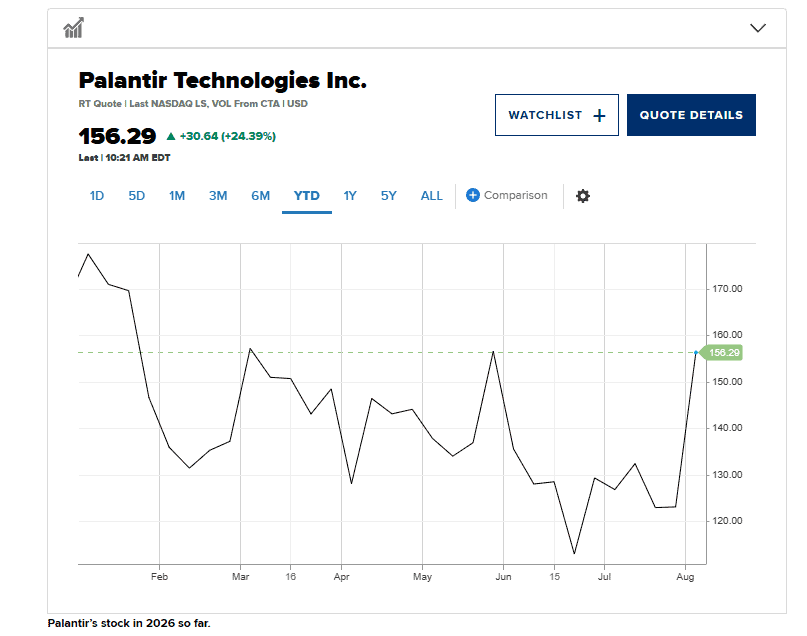
Palantir shares surged as much as 20% on Tuesday after the company reported exceptionally strong second-quarter results, driven by a sharp increase in demand for enterprise AI solutions focused on data sovereignty and privacy.

Palantir shares surged as much as 20% on Tuesday after the company reported exceptionally strong second-quarter results, driven by a sharp increase in demand for enterprise AI solutions focused on data sovereignty and privacy.
The software company reported $1.94 billion in revenue for the quarter, up 93% from approximately $1 billion a year earlier and well above market expectations of $1.8 billion.
Commercial revenue climbed 149% year over year to $764 million, while government revenue increased 90% to $809 million, highlighting strong momentum across both business segments.
Following the results, Palantir raised its full-year outlook, forecasting total revenue between $8.15 billion and $8.158 billion, with commercial revenue expected to exceed $3.424 billion.
AI Sovereignty Is Becoming a Major Enterprise Priority
Palantir attributed its strong performance to growing demand from organizations seeking greater control over their data as AI adoption accelerates.
Unlike companies that send sensitive information directly to large language model providers, many enterprises are increasingly looking for AI systems that allow them to keep proprietary data within their own infrastructure while still benefiting from AI capabilities.
CEO Alex Karp described the quarter as "otherworldly" and said the company remains highly optimistic as what he called the "AI sovereignty revolution" continues to gain momentum.
Speaking with CNBC, Karp noted that businesses at Palantir's scale have rarely delivered growth at this pace.
In a letter to shareholders, he wrote that more organizations are choosing to maintain control of their own data rather than handing critical information to external AI model providers.
Analysts See Stronger Competitive Position
Although Palantir shares had experienced significant volatility earlier this year, analysts said the latest earnings reinforce the company's competitive advantages.
Citi analysts noted that the results weaken concerns that increasing competition in enterprise AI would slow Palantir's growth. They believe the company's ability to integrate AI into existing enterprise systems while protecting customer data continues to differentiate it from many AI competitors.
The strong rebound in commercial demand also suggests that enterprise AI spending remains healthy despite broader market uncertainty.
As companies continue investing in AI, demand is increasingly shifting beyond simply accessing large language models toward deploying AI securely within existing business operations.
For Palantir, that shift appears to be translating into accelerating commercial growth and renewed investor confidence.