
After welcoming their first child, Sue and Tony began thinking...
Read MoreRenters Now Beating Homeowners in Canada: How Investing Outpaces Property Ownership
In a surprising twist for the Canadian housing market, a new PWL Capital study finds that renters — not homeowners — have seen faster wealth growth in most major cities, including Toronto.
1. Renting Doesn’t Mean Falling Behind
The study examined data from 2005 to 2024 across 12 metropolitan areas, comparing home equity growth with investment returns from renters who invest the difference between rent and mortgage costs.
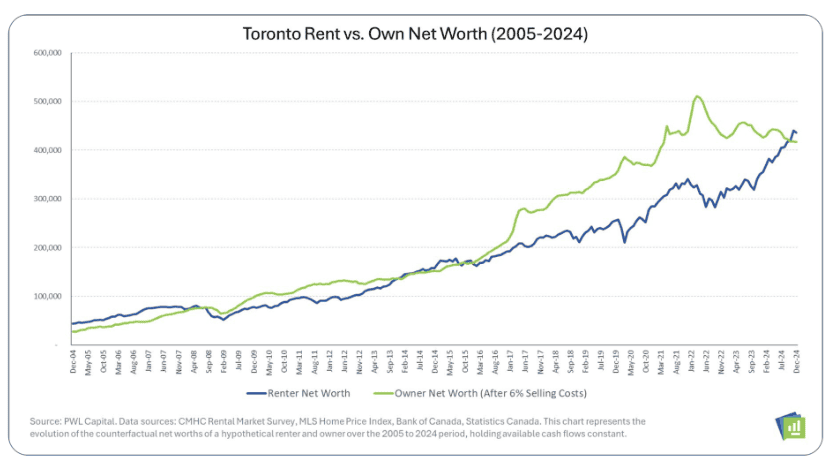
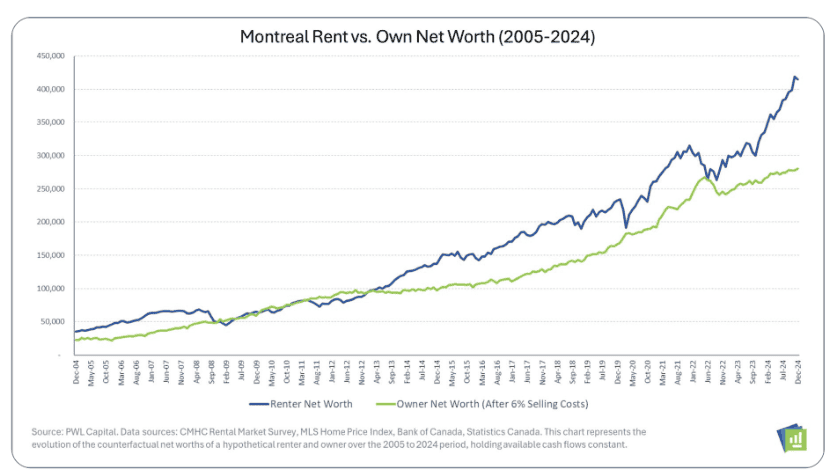
Nationally, renters achieved 99% of homeowners’ net worth, and in cities like Toronto, Ottawa, and Montreal, renters actually came out ahead.
While homeownership has long been viewed as the safest path to wealth, the study shows that compound investment returns can match or exceed real estate appreciation, especially in markets where property values have stagnated.
2. Why Renters Are Winning
This phenomenon is not about cheap rent — it’s about efficient capital allocation.
When interest rates rise and housing prices plateau, homeowners face growing mortgage, tax, and maintenance costs.
Renters who invest the savings instead gain from steady 8.6% annualized returns on diversified ETFs held in tax-sheltered accounts (RRSP, TFSA, FHSA).
For example, if buying costs $2,000 per month while rent is $1,100, investing the $900 difference can result in higher net wealth over 20 years than property appreciation alone.
3. City-by-City Results
Montreal: Renters hold a clear lead — 48% higher net worth than homeowners.
Toronto: Long-term gains for owners have faded; renters slightly outperform in 2024.
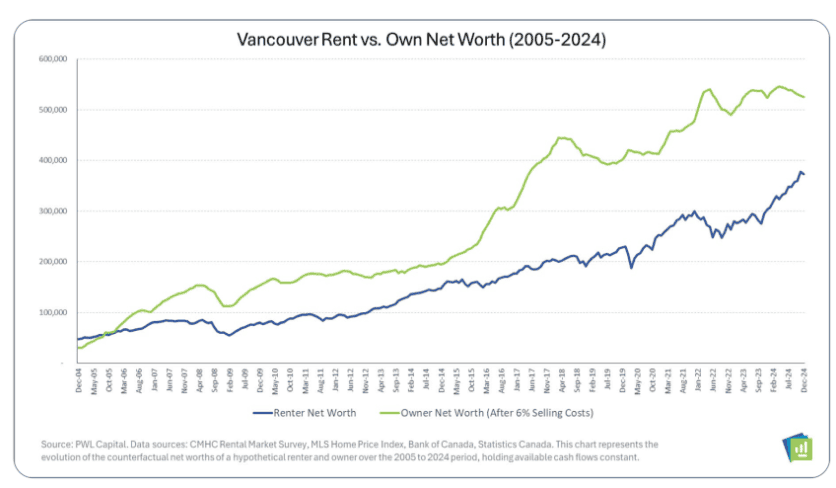
Vancouver: Homeowners dominate (0.71 renter/owner ratio) due to high rents limiting savings.
Calgary: Both groups grow wealth, but homeowners still hold the edge (0.37 ratio).
The study concludes there is no single “winner” across Canada — returns depend on timing, interest rates, and local housing cycles.
4. Compounding Wins Over Real Estate
The math of wealth remains unchanged: time beats timing.
Starting early, even with smaller contributions, outperforms waiting to buy property later.
A $500 monthly investment starting at age 20 can grow to $2.27M by age 67, compared to $2.17M for those starting at age 40 with $2,000 monthly.
Real estate offers leverage — but compound returns offer freedom.
You may also interested in
Ms. W’s Case Study: From Retirement Worries to Building a Family Legacy | AiF Clients
Ms. W, a healthcare therapist in her 60s, spent years...
Read MoreMr. M’s Story: From Starting Over in Canada to Rebuilding his Career and Financial Future | AiF Clients

Discover how an immigrant had to leave behind his successful...
Read MorePenny’s Case Study: When AI Created Uncertainty, Investing Created Confidence| AiF Clients

Discover how uncertainty can create confidence over time through Penny's...
Read MoreFrom Business Challenges to Investment Confidence: Susan’s Story| AiF Clients
Susan's story demonstrates how diversifying beyond a single source of...
Read More