
US Inflation January 2026: CPI Slows to 2.4% but Essential Costs Stay High

Feb 13, 2026

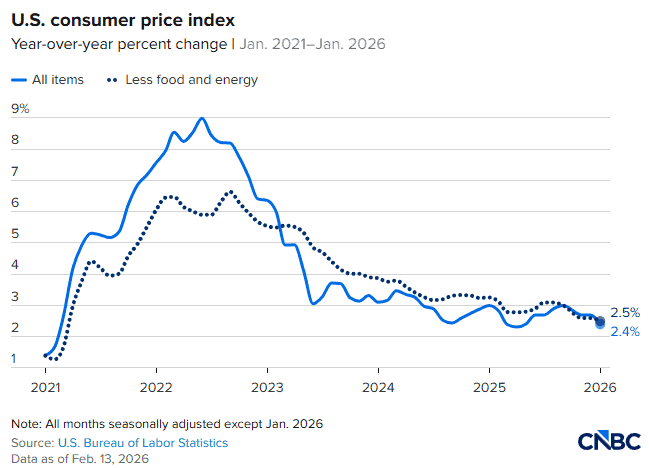
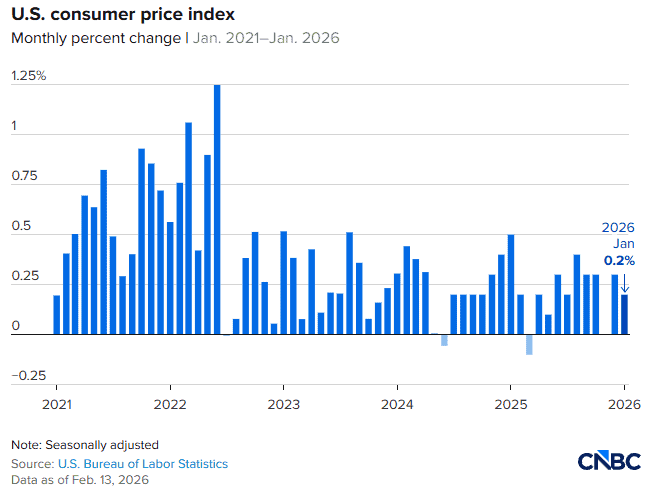
US inflation January 2026 showed signs of moderation, with the Consumer Price Index (CPI) rising 2.4% year over year, down from 2.7% in December and below market expectations. While headline inflation cooled, price pressures in key household categories remain stubbornly high.

The Bureau of Labor Statistics reported that January’s slowdown reflected easing pressures in food and gasoline prices. However, electricity, home heating and several service categories continued to post elevated increases.

Inflation Slows, But Remains Above Target

The Federal Reserve’s long-term inflation target is around 2%, meaning the latest reading remains above policymakers’ preferred range.

Moody’s chief economist Mark Zandi noted that without recent tariff and immigration policies, inflation might already be closer to target levels. Tariffs imposed on multiple trade partners have added upward pressure, as businesses pass at least part of import costs onto consumers. Meanwhile, immigration policies that limit labor supply may be contributing to higher service-sector prices.

Zandi commented that while inflation is still too high for most Americans and the Federal Reserve, the worst phase may have passed. However, policy continuity — particularly regarding tariffs and immigration — will influence whether inflation continues to ease.

The Yale Budget Lab estimated in January that the effective US tariff rate has risen to 16.9%, the highest level since 1932. The Supreme Court is expected to rule soon on the constitutionality of several major tariff measures.

A Statistical Distortion in the CPI Data

Some economists caution that January’s inflation figure may look better than reality.

Due to a prolonged federal government shutdown from October 1 to November 12, inflation data collection was disrupted. During the period without complete data, the Bureau of Labor Statistics assumed no price increases across many categories.

Zandi stated that if those missing data points were properly accounted for, CPI inflation might be closer to 2.7%, rather than 2.4%. This statistical distortion complicates interpretation of the recent slowdown.

Will the Fed Change Course?

The inflation report comes as President Trump has publicly called for lower interest rates and recently nominated Kevin Warsh to replace Federal Reserve Chair Jerome Powell, whose term ends in May.

However, economists largely believe the January report will not accelerate rate cuts.

Oxford Economics chief economist Bernard Yaros wrote that while the downside surprise is welcome news, monetary policy decisions will not shift based on a single month’s data. He added that lingering data distortions, solid growth prospects and a stabilizing labor market are likely to keep the Fed on hold until at least June.

Where Prices Are Falling — and Rising

Several essential categories showed improvement, while others remain elevated.

According to CPI data:

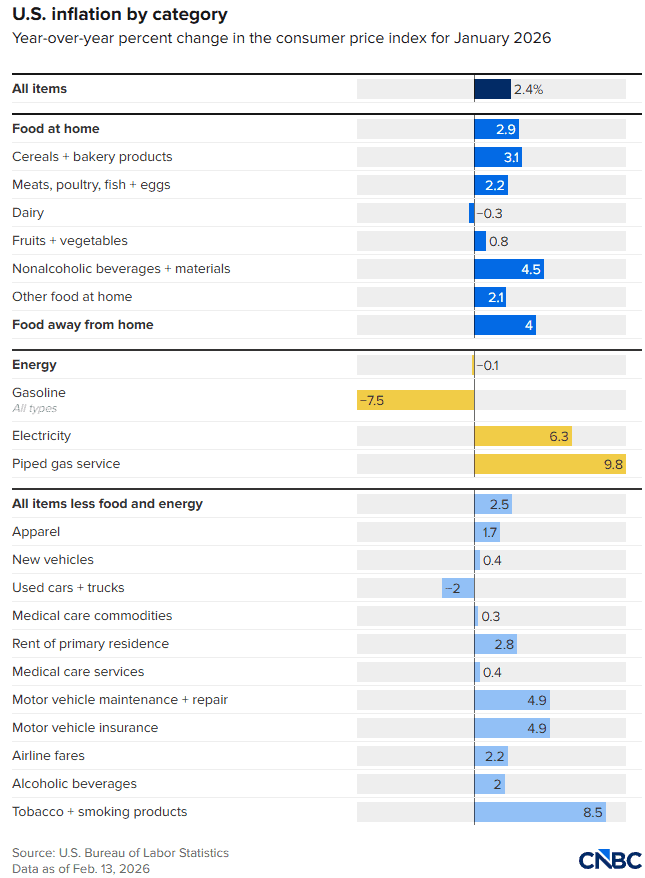
• Gasoline prices fell roughly 3% month over month and 7.5% year over year
• Food prices, including groceries and dining out, rose 2.9% year over year
• Utility gas services increased approximately 10% year over year
• Beef prices rose about 15%
• Coffee prices increased roughly 18%
• Homeowner and renter insurance climbed around 7%
• Electricity prices rose approximately 6%

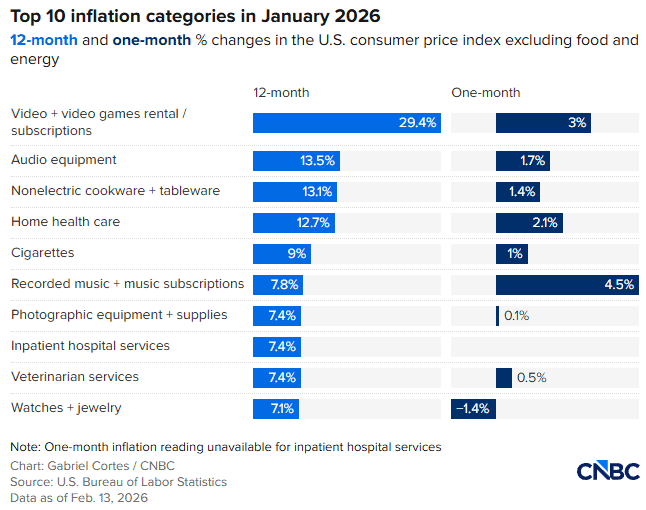
Zandi noted that, excluding gasoline, most essential household categories are still running above target levels, often exceeding 3%.

Some increases stem from structural factors. Beef and coffee prices reflect supply constraints. Insurance costs are rising as climate-related risks are priced into premiums. Electricity prices are being pushed higher partly by increased power demand linked to data center expansion and artificial intelligence development.

The Bigger Picture

While US inflation January 2026 shows moderation at the headline level, underlying pressures remain uneven. Trade policy, labor supply constraints and sector-specific shocks continue to shape price dynamics.

For policymakers, the key question is whether cooling headline inflation reflects durable disinflation or temporary statistical and sector-driven effects.

For households, the reality is more immediate: even as CPI slows, essential living costs remain elevated, limiting relief.

Subscribe
Notify of
guest
0 Comments
Inline Feedbacks
View all comments

You may also interested in