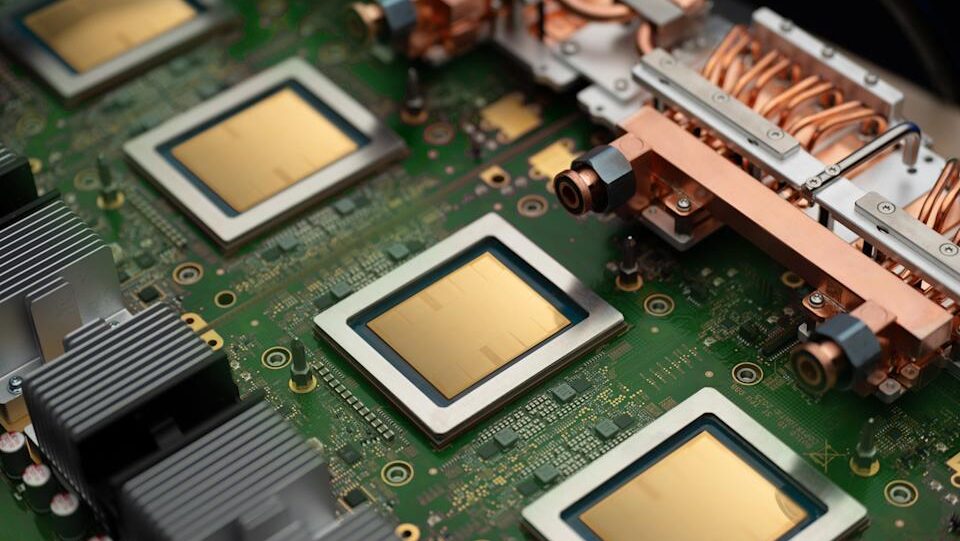
The competition for artificial intelligence hardware is intensifying, and Google is making a significant architectural shift. With its latest generation of Tensor Processing Units (TPUs), the company is moving away from a one-size-fits-all approach and introducing separate chips for AI training and inference.
This marks a notable evolution in AI infrastructure design and reflects a broader industry trend toward specialization.
A Shift Toward Specialized AI Hardware
In previous generations, Google’s TPUs were designed to handle both training and inference workloads. With its eighth-generation TPU, however, the company is splitting these functions into dedicated processors.
According to Google, this change is driven by the growing complexity of AI applications, particularly the rise of AI agents that require faster response times and more efficient execution. By tailoring chips to specific workloads, the company aims to improve performance and scalability.
Both the training and inference chips are expected to be available later this year.
Big Tech Expands Custom Chip Development
Google is not alone in this strategy. Major technology companies are increasingly investing in custom silicon to reduce reliance on traditional GPUs and optimize for specific use cases.
Amazon has developed its own Inferentia and Trainium chips for inference and training, respectively. Microsoft recently introduced a second-generation AI processor, while Meta is working with Broadcom on multiple AI chip designs.
Even Apple has long integrated AI-focused neural engines into its in-house chips.
Together, these efforts highlight a growing industry-wide shift toward vertical integration in AI hardware.
Performance Gains and Memory Enhancements
Google reports that its new training chip delivers approximately 2.8 times the performance of its previous-generation TPU at the same cost, while the inference chip offers an 80% performance improvement.
A key enhancement is the increased use of static random-access memory (SRAM). Each chip includes 384MB of SRAM—three times more than the prior generation—helping improve throughput and reduce latency.
This architecture is designed to support large-scale AI workloads, including the simultaneous operation of millions of AI agents.
Notably, Nvidia is also emphasizing SRAM in its next-generation hardware, underscoring the importance of memory design in modern AI systems.
Growing Adoption Across Industries
Google’s AI chips are seeing increasing adoption across industries. The company noted that Citadel Securities is using TPUs for quantitative research, while all 17 U.S. Department of Energy national laboratories rely on AI tools built on the platform.
AI startup Anthropic has also committed to using large-scale TPU capacity for its models.
Analysts suggest that the TPU ecosystem, combined with Google DeepMind, represents a substantial long-term growth opportunity for Google.
The AI Chip Race Continues
Despite these advancements, Nvidia remains the dominant force in AI hardware. None of the major tech companies have displaced its leadership, but competition is clearly intensifying.
The industry is moving beyond raw processing power toward more specialized, efficient architectures. As AI adoption accelerates, the ability to design and deploy optimized hardware will likely remain a key differentiator.