
Google Joins the Dow: A Historic Marker of the Fourth Industrial Revolution
Google’s entry into the Dow Jones Industrial Average is more than an index change. It signals that AI has entered the core of America’s capital system and that the Fourth Industrial Revolution is moving into a new phase.
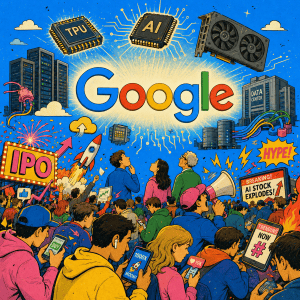
This Is Not Just News. It Is a Historical Marker.
Google joining the Dow Jones Industrial Average is not simply another index adjustment.
In our view, it marks a new phase of the Fourth Industrial Revolution.
The Dow Jones Industrial Average was founded in 1896 and remains one of the most recognizable stock indices in the world. Its 30 members come from different industries, each representing a major part of the U.S. economy. Each member is generally a leader in its own field.
Joining the index is not only about being large enough. It means that a company is increasingly viewed as an important part of America’s economic future.
Over the decades, the Dow has reflected the evolution of manufacturing, consumer businesses, finance, and the internet era. Today, Google’s addition signals that AI has entered the most central layer of America’s capital system.
For long-term investors, this is not merely an index rebalancing. It is a directional signal.
Alphabet continues to expand its AI investments. Microsoft, NVIDIA, Amazon, and other technology giants are also increasing AI-related capital spending. The U.S. capital market is now committing real capital to the next industrial revolution.
As more of the world’s leading companies concentrate their capital expenditure on AI, the centre of future wealth creation is beginning to shift.
If the internet defined the technology industry of the past two decades, AI may define the economic landscape of the next two decades.
The signals that matter most are not always the ones receiving the most attention on a given day. They are often the ones quietly changing the direction of capital.
Why This Important Signal Received So Little Attention
If you did not see this news on the evening of June 23, that is completely understandable.
At 5:23 p.m. local time on June 23, Alphabet, Google’s parent company, was announced as a new member of the Dow Jones Industrial Average, replacing Verizon.
According to S&P Global, Google was added to strengthen the index’s representation in artificial intelligence (AI), cloud infrastructure, and digital advertising.
Following the announcement, Alphabet shares rose about 1% in after-hours trading.
Alphabet has also continued to invest heavily in AI. Since last year, the company has raised approximately US$141 billion and has continued to invest in AI infrastructure, data centres, and cloud computing in an effort to build a complete AI ecosystem and meet future computing demand.
Google is scheduled to officially join the Dow Jones Industrial Average on Monday, June 29.
It is a piece of news that could influence investment direction for many years to come.
Yet relatively few people saw it.
The reason is simple.
It was released at 5:23 in the afternoon.
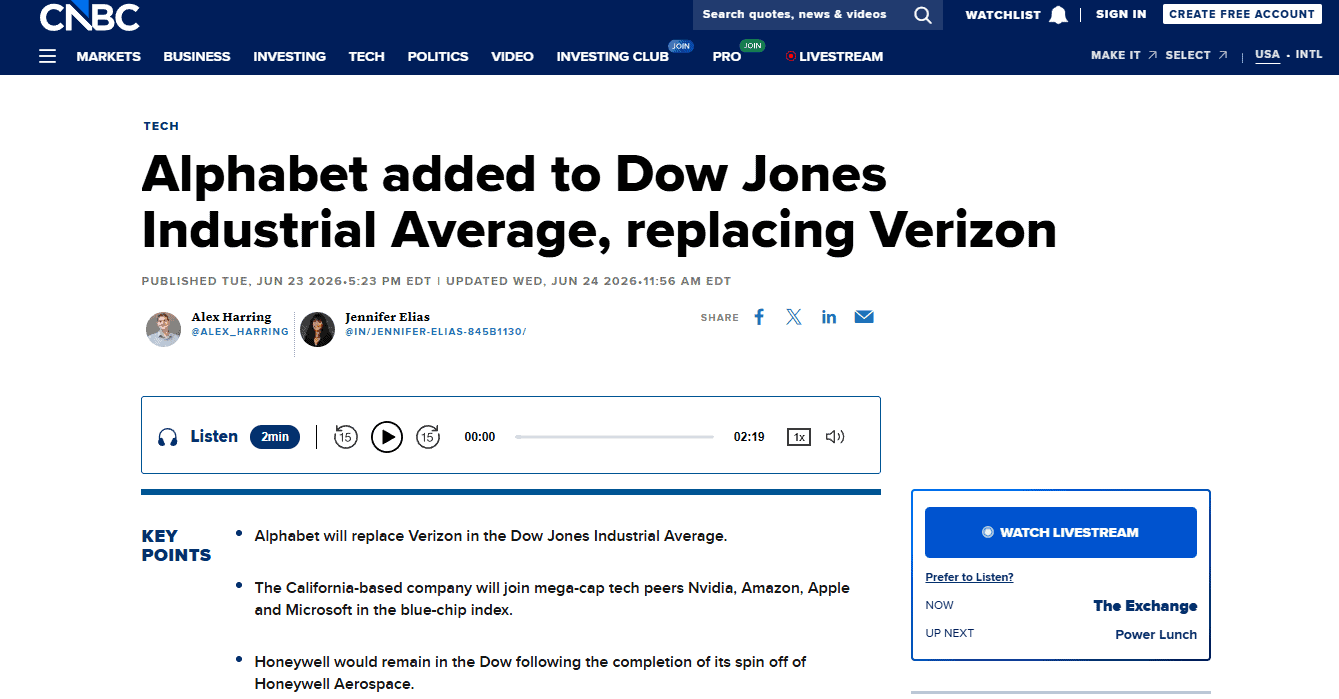
At that time, most people were just leaving work, commuting, or preparing dinner. By the time many people sat down to open CNBC, the story had already been pushed lower on the page by newer headlines.
By contrast, SpaceX’s IPO the week before dominated financial media from before the listing to after the listing. Live coverage, feature stories, countdowns, and social-media commentary were everywhere.
Why do events of similar importance receive such different levels of attention?
That is a question we have been thinking about for years.
Ai Financial has a market view that comes from years of observing capital markets:
Many of the events that truly reshape wealth are quiet when they happen. By the time everyone is discussing them, the market has often already moved much further ahead.
For long-term investing, we care more about where capital is ultimately flowing than which headline receives the most traffic today.
Google joining the Dow may be exactly this kind of signal. It did not arrive with overwhelming publicity, but it may become an important milestone in the Fourth Industrial Revolution’s move into a new stage.
Years from now, looking back, we may find that the importance of this day was far greater than the attention it received at the time.