Mason · Investment Loan Accounts
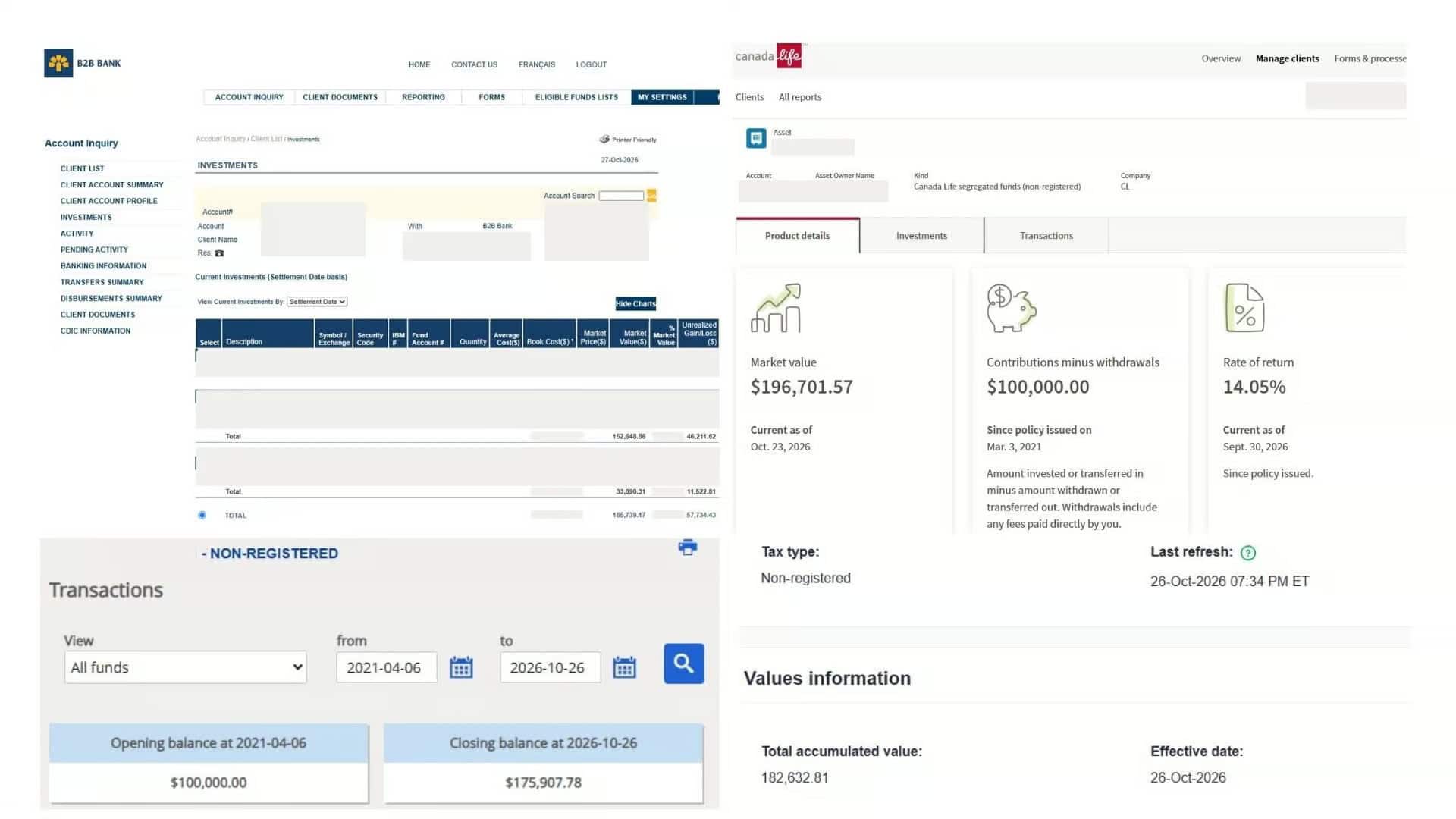
Four investment loans totalling $400,000, now valued at $740,981.

Mason works in AI research and Olivia works in IT. They have two children and solid incomes. In 2020, an Ai Financial online investment seminar led them to rethink how they were building their family's assets. Starting with $675,000 in investment loans and holding through the 2022 market decline, the couple's investment accounts are now worth more than $1.5 million.
Their paycheques support the family today, while their investment accounts prepare for longer-term goals. While their careers were stable, Mason and Olivia first built an investment loan portfolio, then gradually added registered accounts such as RRSPs and TFSAs.
Mason $400,000, Olivia $275,000
Investment loans + registered accounts
Including $62,000 already withdrawn
After $204,325 in loan interest
As of October 27, 2026. Account values include assets purchased with borrowed funds and should not be read as the family's net worth after repaying the loans. Withdrawals are included in cumulative investment gains.
Mason works on AI research at an electronics and technology company, and Olivia works in IT. Both have specialized skills and good incomes, but their mortgage, their children's education, daily family life and future retirement all still need ongoing funding.
Working in tech, they saw early on the opportunities that artificial intelligence could create. They also understood that no career can guarantee today's income level forever.
During the pandemic, the couple came across an Ai Financial online investment seminar. The idea behind investment loans caught their attention: after a full review of income, assets, cash flow and risk tolerance, could a loan help them increase their long-term investment capital sooner?
Mason moved first. Starting in December 2020, he opened four investment loans totalling $400,000. In October 2021, Olivia followed with three loan accounts totalling $275,000. The couple invested the loan proceeds in segregated funds from several insurance companies.
They kept working and later added registered accounts such as TFSAs and RRSPs, so their family investing did not depend on a single source of funds or a single account.
Not long after they built their long-term portfolio, stock markets declined through 2022, with technology stocks under particular pressure. For families using investment loans, market swings come on top of ongoing interest costs. Mason and Olivia went through that test, and later through further changes in interest rates and markets, without letting short-term moves pull them away from their long-term plan.
Both work in technology and follow the industry changes and investment opportunities that AI may bring. At the same time, they continue to manage household cash flow, borrowing costs and asset allocation. For a dual-income family like theirs, planning early is about creating more financial options, not betting on a single market theme.
Below are the couple's investment loan accounts and other investment accounts, shown by account type. The images come from the clients' actual account records, with personal details masked.
Four investment loans totalling $400,000, now valued at $740,981.

Three investment loans totalling $275,000, now valued at $462,969.
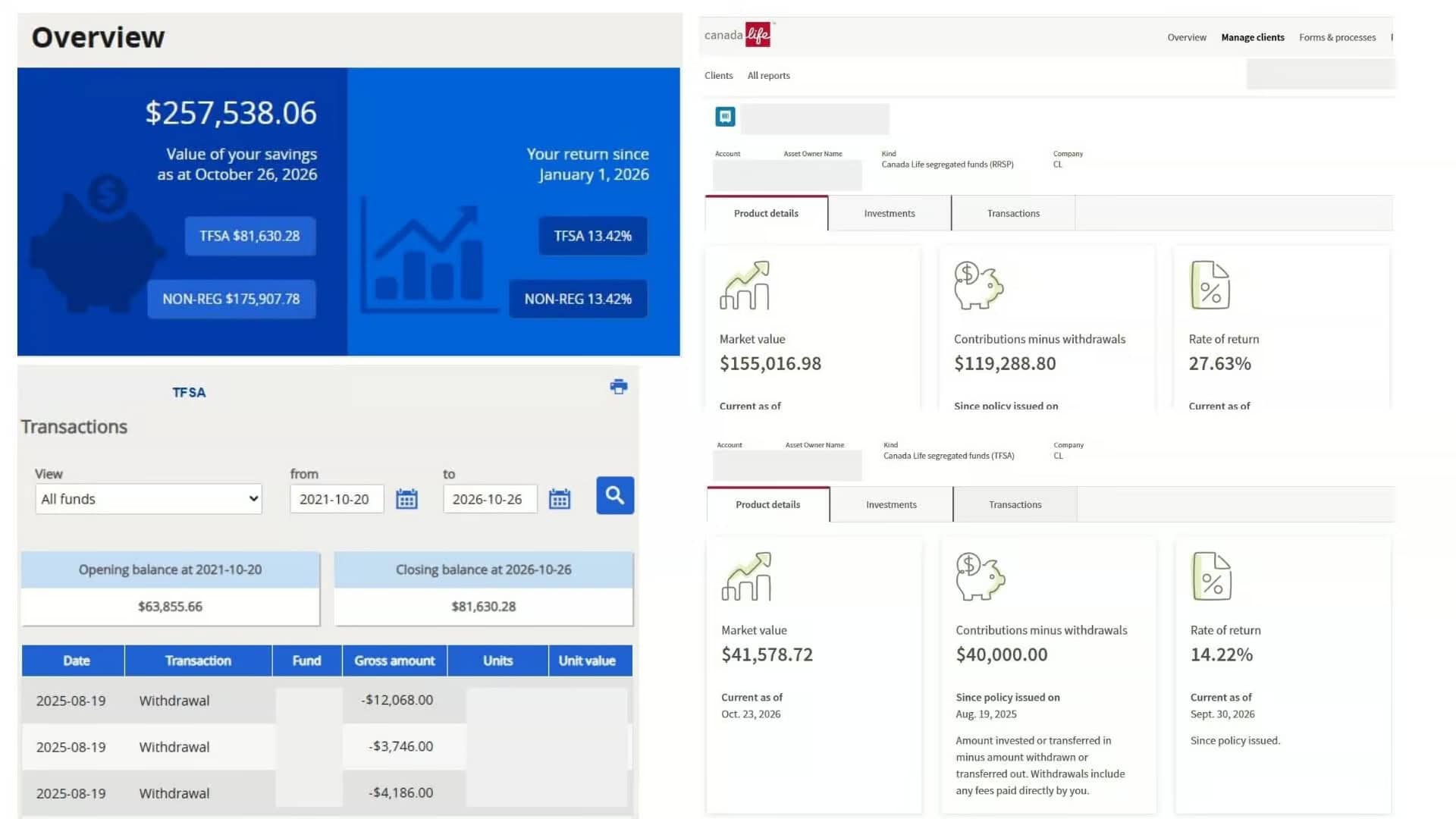
Long-term investment accounts including a TFSA and RRSP.

Long-term investment accounts including a TFSA and RRSP.
The family overview shows the combined result of six years of investing. Below, the husband's and wife's loan investments and registered accounts are shown separately, with principal, gains, interest and leveraged returns.
Started investing in 2020 with four investment loans totalling $400,000, plus TFSA and RRSP accounts.
Registered accounts: $252,873.01 invested, current value $278,225.98, $50,000 withdrawn, cumulative gains of $75,352.97.
Started investing in October 2021 with three investment loans totalling $275,000, plus RRSP and TFSA accounts.
Registered accounts: $31,400 invested, current value $30,713, $12,000 withdrawn, cumulative investment gains of $11,313.
| Client / Account | Loan principal | Current value | Net return after interest | Investment return | Leveraged return |
|---|---|---|---|---|---|
| Mason / Manulife | $100,000 | $182,632.81 | $50,999.48 | 82.63% | 161.22% |
| Mason / B2B · iA | $100,000 | $185,739.17 | $54,105.84 | 85.74% | 171.04% |
| Mason / NBC · Canada Life | $100,000 | $196,701.57 | $65,868.24 | 96.70% | 213.63% |
| Mason / iA | $100,000 | $175,907.78 | $45,341.11 | 75.91% | 148.34% |
| Olivia / iA | $100,000 | $165,750.00 | $36,783.33 | 65.75% | 126.99% |
| Olivia / Manulife | $75,000 | $125,713.46 | $28,988.46 | 67.62% | 133.43% |
| Olivia / NBC · Canada Life | $100,000 | $171,505.70 | $42,539.03 | 71.51% | 146.86% |
| Couple's loan accounts total | $675,000 | $1,203,950.49 | $324,625.49 | 78.36% | 158.88% |
Leveraged return is the net return after loan interest paid divided by the interest cost. It is not the return of the funds themselves and does not mean the loan principal has been repaid.
Artificial intelligence is changing competition and career opportunities across the tech industry. Mason and Olivia still work in the field and continue to follow the next wave of technology. Whatever happens in their industry, they have already built a meaningful family investment portfolio through long-term investing.
Give investments a longer time horizon while you are young, commit capital you can afford while you have income, stay disciplined through market swings, and manage cash flow and risk over the long run. These are the family investing principles they have followed since 2020. Investment loans are not suitable for every family, and any plan must rest on a real ability to service debt and an honest view of risk tolerance.
Ai Financial can review your family's income, assets, cash flow, investment horizon and risk tolerance to help assess whether investment loans, segregated funds and registered account strategies may be suitable for you.
Investment loans involve interest costs, market risk and repayment obligations, so it is important to assess whether they fit your family's situation.
See how different families combine investment loans, segregated funds and registered accounts to build long-term investment plans that fit their own situation.
View More StoriesDisclaimer: This case is based on a specific client's historical account records, and the clients' names have been changed. Historical data is shared for illustrative and educational purposes only and does not constitute financial, investment, insurance, lending, tax or legal advice. Investment loans involve interest costs and repayment obligations and can magnify investment losses. Segregated fund guarantees, fees, terms and conditions vary by contract. Past performance does not guarantee future results. Investment returns shown include amounts withdrawn, and account values include assets purchased with borrowed funds. Any investment decision should take into account your personal financial situation and professional advice.