
AI Investment Enters a Super Buildout Phase: Technology Revolution, Valuation, and Risk Discipline
Global AI spending is accelerating across chips, data centres, cloud computing, power, software, model training, and enterprise applications. AI is becoming economic infrastructure, but investors still need to separate technological value from stock prices, profitability, cash flow, debt, and valuation risk.
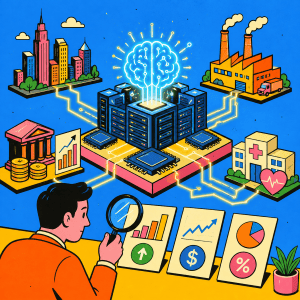
In 2026, global investment in artificial intelligence continues to expand rapidly. According to related institutional forecasts cited in the source material, total AI spending for the year could reach US$2.5 trillion, covering chips, data centres, cloud computing, power, software, model training, and enterprise applications.
This scale is far beyond the early infrastructure phase of the internet. It also shows that AI is quickly moving from a technology product into a new generation of economic infrastructure.
At the same time, the rapid increase in capital investment raises an important question: direct revenue generated by AI-related companies remains far below the industry’s total investment scale. Based on the data referenced in the article, global direct AI service revenue in 2026 is about US$250 billion, still far below the US$2.5 trillion spending level.
This does not mean the AI development thesis is broken. It is more of a reminder for investors: the AI technology revolution is real, but technological value, corporate earnings, and stock prices do not always grow at the same speed.
AI Is Going Through an Unprecedented Infrastructure Buildout
Major global technology companies are spending enormous amounts of capital to build AI infrastructure.
Microsoft, Google, Amazon, Meta, Oracle, and other large cloud computing companies are accelerating data centre construction, chip purchases, power supply expansion, new AI model development, and enterprise AI services. According to estimates cited in the source material, the five largest hyperscale cloud providers could spend between US$690 billion and US$805 billion on capital expenditures in 2026.
Alphabet alone plans annual capital expenditures of approximately US$195 billion to US$205 billion. Goldman Sachs estimates that from 2025 to 2027, total capital expenditures by hyperscale technology companies could reach US$1.15 trillion.
The scale of this buildout has already exceeded early internet-era investments in fibre optic and telecom infrastructure.
AI does not require only software. It also requires advanced chips, data centres, power, cooling systems, copper, networking equipment, and large numbers of specialized professionals. As a result, AI investment is affecting the real economy and capital markets at the same time.
From this perspective, AI is no longer only a trend inside the technology industry. It is becoming an important infrastructure layer of the Fourth Industrial Revolution.
Massive Investment Does Not Immediately Become Profit
Large capital expenditures do not immediately turn into revenue and profit of the same size.
The source material notes that OpenAI generated about US$13.07 billion in revenue in 2025, while recording a net loss of US$38.5 billion. At the same time, many companies have already tested or deployed AI, but have not yet seen a clear impact on their income statements.
A related MIT report cited in the article indicates that about 95% of enterprise AI pilots have not yet produced a measurable impact on profit. An IBM CEO survey also suggests that only about one quarter of AI projects have achieved their expected return on investment.
These numbers show that companies broadly believe AI can improve productivity, but moving from testing to deployment and then to stable profits still takes time.
Railroads, electricity, and the internet all went through similar phases. Infrastructure usually has to be built first. Companies need to invest capital, cultivate the market, and search for the right business model before stable returns can appear.
Therefore, the gap between high AI investment and relatively low direct AI revenue today is not surprising. The key question is whether future application demand can keep growing, and whether companies can ultimately turn technological capability into cash flow and earnings.
More Debt Financing Means the Risk Is No Longer Limited to Stocks
This AI buildout differs from the internet bubble in one important way: part of the investment is coming from bonds and private credit, not only venture capital and equity financing.
The source material notes that Meta financed nearly US$30 billion for a Louisiana data centre through Blue Owl Capital. Google raised about US$140 billion, including approximately US$55 billion in debt. Amazon’s related debt was about US$64 billion.
In the first half of 2026, technology giants issued about US$182 billion of investment-grade bonds, a significant year-over-year increase.
Debt itself does not mean a project is problematic. For large technology companies with stable cash flow, using bonds to finance long-term assets is a common corporate finance practice.
But debt raises the requirements for project returns and cash flow. If future AI demand falls short of expectations, or if data centre construction costs, energy prices, and financing costs continue rising, risk could spread from stock valuations into bonds, private credit, and other financial institutions.
That is why investors need to monitor both revenue growth and balance sheets, rather than focusing only on AI narratives, capital expenditure, and future market size.
Circular Investment Can Accelerate Growth, but Revenue Quality Matters
The AI industry has already formed a complex web of investment and purchasing relationships.
Chip companies invest in AI companies, and AI companies then use those funds to buy chips. Large technology companies invest in startups, and startups then purchase cloud computing services from those same technology companies. Capital circulates within the industry, accelerating model development, chip demand, and data centre construction, while helping new firms grow quickly.
But this structure can also make revenue and investment highly connected.
When a company’s customer is also its investee, investors need to ask a deeper question: is the revenue coming from independent market demand, or is it mainly supported by continued internal industry financing?
This does not mean these transactions have no value. It means that when evaluating AI companies, investors should not look only at headline revenue growth. They should also examine customer concentration, payment ability, contract duration, and end-user demand.
Only when more traditional companies, consumers, and governments are willing to keep paying for AI products can the industry move from the infrastructure buildout phase into a more mature commercialization phase.
The AI Sector Is Starting to Split
As capital investment rises, the market has started to reassess the investment returns of different AI companies.
The model cited in the source material shows that the incremental return on invested capital for the five largest technology companies has declined from about 40% to 20%. If capital expenditures continue to grow quickly while revenue growth fails to keep pace, returns could fall further.
At the same time, the AI sector is showing clear divergence. Semiconductor and infrastructure companies continue to benefit from chip demand, while some cloud and platform companies are facing questions about excessive capital expenditure, free cash flow, and investment returns.
This divergence does not necessarily mean the AI theme is over.
On the contrary, it may show that the market is moving away from the early phase where almost every AI-related company rises, and toward a stage where investors try to identify the real winners.
Companies that continue to receive capital support in the future will need to prove that they have technological advantages, customer demand, stable revenue, sufficient cash flow, and long-term returns above their cost of capital.
Technology Revolutions and Asset Bubbles Can Exist at the Same Time
Historically, major technology revolutions have almost always been accompanied by capital excess.
In the 19th century, railroad investment produced large amounts of duplicated construction and failed projects. After the bubble ended, however, the railroad network still supported industrial development. During the internet bubble, many companies failed, but fibre networks, servers, and internet infrastructure remained, later enabling e-commerce, cloud computing, and mobile internet.
AI may go through a similar process.
Even if some projects are overbuilt and some company valuations fall, data centres, chip capacity, models, software tools, and specialized talent may remain inside the economy. These assets could continue to change healthcare, manufacturing, finance, education, logistics, and enterprise management.
That is why judging whether AI has long-term value and judging whether a specific AI stock is attractive at today’s price are two different questions.
AI is a real technology revolution, but that does not mean every AI company will succeed. AI will change society, but that does not mean every valuation is reasonable.
Ai Financial: We Are Bullish on AI, and We Still Believe in Value and Discipline
Ai Financial continues to be bullish on AI and the Fourth Industrial Revolution.
AI is improving efficiency in software development, financial services, data analysis, manufacturing, healthcare, and enterprise management. Revenue growth and business changes at Microsoft, Google, Amazon, and other large companies also show that AI is no longer just a concept.
AI changing human society has already become reality.
At the same time, being optimistic about an industry for the long term does not mean chasing every company with an AI label. It also does not mean buying at any price.
The internet eventually changed the world, but many internet companies still failed. Railroads eventually supported industrialization, but many railroad projects did not reward early investors. The technology direction can be right, while the company selection or entry price can still be wrong.
That is why Ai Financial pays more attention to companies that can turn AI into real revenue, earnings, and cash flow, while maintaining long-term competitive advantages. For projects supported mainly by stories, financing, and short-term market sentiment, we remain cautious.
The technology is far from reaching its full potential. But investment decisions still need to be based on facts, value, and long-term returns.