
Canada’s Job Market Is Changing: A 25-Year-Old IT Graduate Can’t Land a Retail Job, While a $300K Worker Now Faces $130K Offers
Canada’s job market is showing an increasingly striking contrast: young graduates are struggling to land their first full-time jobs, while experienced professionals who once commanded high salaries are discovering that those salaries may no longer exist.

Canada’s job market is showing an increasingly striking contrast: young graduates are struggling to land their first full-time jobs, while experienced professionals who once commanded high salaries are discovering that those salaries may no longer exist.
Two recent discussions on Canadian Reddit communities illustrate both ends of the problem. One involves a 25-year-old university graduate with an IT-related degree and two years of federal government experience who says he is being rejected even for retail jobs. The other involves a worker who previously earned about $300,000 a year but, after being laid off, says comparable opportunities are now paying only around $100,000 to $130,000.
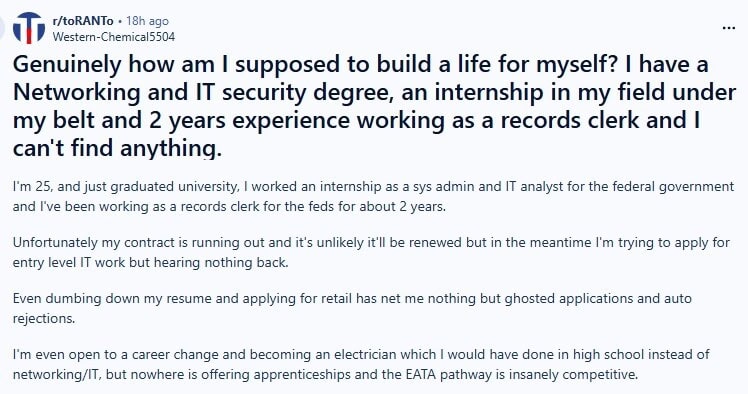
25 Years Old, an IT Degree and Government Experience — Yet Even Retail Jobs Say No
The first poster is 25 years old and recently graduated with a degree related to networking and IT security.
He also has more experience than the typical new graduate. During university, he spent two years working with the federal government in roles including systems administration and IT analysis.
By traditional standards, that would appear to be a strong résumé for someone entering the workforce.
But as his government contract approaches its end, applications for entry-level IT positions have produced few results.
Eventually, he began applying for retail jobs simply to secure an income. Even then, applications were either met with silence or automated rejection messages.
His story quickly resonated with other young Canadians. Some commenters said they had degrees in fields such as mathematics and mechanical engineering but were still unable to find relevant employment. Others said they had even applied to grocery stores and been rejected.
One IT professional with 14 years of experience said he had recently been laid off and was returning to Calgary with his severance package.
Changing careers may not provide an easy escape either. The original poster considered becoming an electrician but found intense competition for EATA apprenticeship opportunities. TTC openings were also limited.
The employment pressure, in other words, is no longer confined to one particular industry.
Does “Just Work Hard and Wait” Still Work?
Some older commenters offered familiar advice: being 25 is supposed to be difficult, careers are marathons rather than sprints, and things will eventually improve with experience.
One person described a friend who earned minimum wage in his twenties before eventually joining RBC, accumulating stocks and pension benefits, and gradually achieving financial stability.
But younger commenters questioned whether the same career path still works today.
One pointed out that a $60,000 salary in 2004 would require roughly $100,000 today to provide similar purchasing power after inflation, while wages for many positions have failed to keep pace with the rising cost of living.
That changes the economics of “waiting it out.”
Previous generations could often accept relatively low starting salaries on the assumption that income would rise steadily with experience. But when housing, food and other expenses rise rapidly while entry-level opportunities shrink, the cost of spending years waiting for career progression becomes much greater.
And the problem is not limited to people trying to enter the workforce.
From a $300K Salary to Jobs Paying $100K–$130K
Another discussion in a Canadian jobs community came from almost the opposite end of the career spectrum.
The poster previously earned approximately $300,000 per year. After being laid off and returning to the job market, however, he found that comparable positions were generally offering only $100,000 to $130,000.
Even successfully finding another job could therefore mean losing more than half of his previous income.
Several commenters argued that this reflects a broader repricing of labour following years of rapid expansion in the technology industry.
During the boom, companies competing aggressively for specialized workers were willing to pay substantial premiums. As businesses cut costs, slow hiring and release more experienced employees back into the labour market, employers gain negotiating power.
If qualified candidates are willing to perform a job for $130,000, companies have little incentive to continue paying $300,000.
AI and Global Outsourcing Are Changing the Price of Work
Two themes repeatedly appeared in these discussions: artificial intelligence and outsourcing.
The rise of remote work demonstrated that many jobs do not require employees to sit inside a Canadian office. But that realization works both ways. If someone can perform a job remotely from Toronto, companies may also ask whether parts of that work can be performed from Latin America, India, the Philippines or other lower-cost markets.
For jobs that can be delivered entirely through a computer, competition is increasingly global.
AI adds another dimension.
Software development, research, data processing, customer service and administrative work that previously required larger teams can increasingly be completed by fewer employees using AI tools.
AI can create new industries and new jobs while simultaneously increasing the productivity of existing workers and reducing the number of people required for certain tasks.
That transformation is beginning to move from prediction to reality.
A $300K-to-$130K Pay Cut Also Reveals the Risk of Depending on Salary
The second case highlights another issue.
As income rises, spending often rises with it: a larger home, a more expensive car and higher recurring household expenses can gradually become normal.
Those expenses may be perfectly manageable on a $300,000 salary.
But if one layoff suddenly resets the market value of that job to $130,000, a lifestyle built around the previous income can quickly become difficult to sustain.
That is why some high-income technology workers in the discussion said they continued living relatively conservatively even while earning around $200,000 or more, directing significant amounts toward TFSA, RRSP and other financial assets.
AiF Insight: The Future of Work Is Changing — Build Your Own Wealth Moat
AI is rapidly increasing productivity. Tasks that once required larger teams can increasingly be completed by fewer people working alongside AI, while remote work allows companies to recruit talent globally. A degree, years of experience or even a previously high salary may no longer guarantee that the same job — at the same compensation — will remain available for decades.
That makes financial independence outside of employment increasingly important.
Working hard, developing valuable skills and increasing income still matter. But relying entirely on the next paycheque means your financial life remains tied to your employer and the labour market.
Consistently turning part of employment income into financial assets such as stocks and funds can gradually build wealth outside of salary. The goal is not to replace a paycheque overnight, but to become less dependent on a single job as those assets grow over time.
The future of employment may become more uncertain. The earlier people begin accumulating financial assets, the more choices they may have when facing layoffs, salary cuts, AI disruption or career changes.