
A First in Canadian Housing: BMO Warns Canada Is Moving Toward a “Nation of Rentals”
Canada’s housing construction boom is cooling, but the bigger change is structural: more new homes are being built for renters, not for owner-occupiers. BMO says Canada is seeing a housing-market shift it has never seen before.
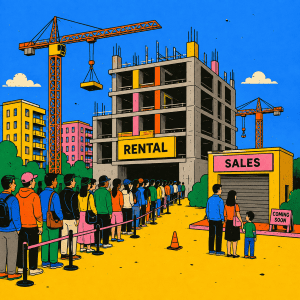
Canada’s real estate construction boom is cooling, but overall activity remains elevated. The more important change is not simply that housing starts are falling. It is that the purpose of newly built housing is changing in a fundamental way.
According to Canada Mortgage and Housing Corporation, the seasonally adjusted annual rate of housing starts fell 6% in June to 239,000 units, marking the third consecutive monthly decline. Even so, about 375,000 homes remain under construction across the country, and the 12-month average of housing starts is still around 256,000 units. In other words, Canada’s housing issue is not that construction has completely stopped.
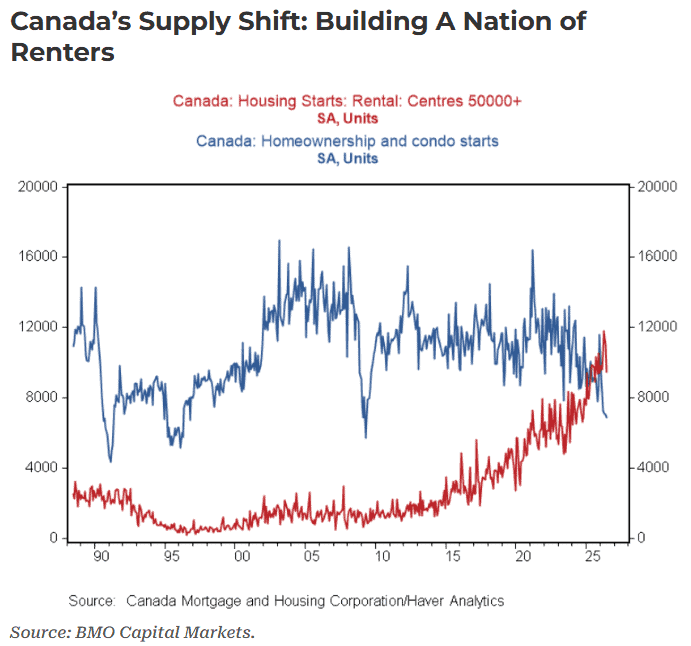
BMO Capital Markets says a trend that Canada has never seen before is now forming: for the first time in Canadian history, most new housing is not being built to sell to owner-occupiers. It is being built directly for the rental market. Canada’s real estate market is increasingly showing the characteristics of a “nation of rentals.”
Housing Starts Are Falling, but Rental Construction Remains Near Highs
Unadjusted data show that from January to April 2026, Canada started construction on about 64,600 homes. Roughly 58.2% of them were intended for rental use.
That means more than half of new housing starts in the first four months of the year were not planned for sale to ordinary homebuyers. They were designed from the beginning to enter the market as long-term rental properties.
BMO senior economist Robert Kavcic said the most important housing-construction development in Canada is the widening split between owner-occupied housing and rental housing.
In major metropolitan areas, housing starts for condos and other ownership-oriented properties have fallen to their lowest levels since the 2009 recession and the mid-1990s. At the same time, purpose-built rental starts remain close to historic highs.
This means Canada’s headline construction numbers can still look relatively strong, while the internal structure has changed dramatically. Projects aimed at ordinary buyers are shrinking, while rental apartments and rental communities are still being built at scale.
The Presale Market Is Weak, and Developers Are Changing Direction
For decades, Canadian residential development relied heavily on presales.
Developers would launch pre-construction projects, collect deposits, sign presale contracts, and use those sales as proof of demand. Strong presales helped them secure financing and move projects into construction.
In recent years, however, new-home and presale sales have remained weak. High home prices, tighter financing conditions, and weaker buyer confidence have made many households unwilling to commit to expensive homes years before completion.
Without enough presales, many ownership-focused projects cannot obtain financing or start construction normally. Developers have therefore begun shifting more projects toward long-term rental housing.
Kavcic noted that this shift reflects both the weakness of the new-home sales market and the tight rental market of recent years, along with government incentives designed to support rental development.
In simple terms, developers have not stopped building entirely. They are moving from “build to sell” toward “build to rent.”
Canada’s New Housing Market Is Being Led by Rentals for the First Time
During past recessions, new housing construction also fell sharply. But usually, all types of residential construction weakened together.
When the economy slows, purchase demand falls, rents often soften, and developers generally have less incentive to build large volumes of rental housing.
This time is different.
Even though new ownership-oriented housing has fallen close to recession-like levels, rental construction remains strong. Government tax incentives, financing support, and other policies continue to encourage rental development, making large developers and institutional investors more willing to enter the long-term rental market.
Canada is therefore seeing a new housing structure for the first time: new supply is increasingly being driven by rental properties rather than ordinary families buying homes.
When BMO refers to Canada as a “nation of rentals,” it does not mean every Canadian will rent forever. It means the primary target of the new-housing market is changing. In the past, residential development revolved around homebuyers. Today, more projects are designed from the start for tenants, landlords, and large institutions.
Ordinary Families May Have Fewer New Homes to Buy
More rental housing can expand rental supply and may help reduce pressure in some cities.
At the same time, the sharp decline in new homes for owner-occupiers may create a different problem.
If developers increasingly depend on rental projects, ordinary homebuyers may face fewer newly built homes to choose from in the future. Some households with stable income may still find that the new-home market offers fewer suitable purchase options, leaving them in the rental market for longer.
The real estate market is therefore being divided into two parts: on one side are institutions and developers with enough capital to hold entire rental buildings over the long term; on the other side are ordinary families facing high home prices, financing pressure, and a harder path into ownership.
Canada has long encouraged homeownership as a way for families to build wealth. Now, policy and market forces are increasingly pushing rental housing. This shift could reshape ownership patterns over the coming decades and change how the real estate industry makes money.
From a Home-Selling Country to a Renting Country
Canadian real estate used to depend on home sales, presale contracts, and rising prices to drive growth.
Developers built homes and sold them. Buyers entered the market with mortgages. Rising prices attracted more capital and more projects. This model helped make real estate one of the most important sectors of the Canadian economy.
But when prices become too high, purchasing power declines, and presales slow down, the old growth model becomes harder to sustain. Developers begin shifting from one-time home sales to long-term rental income. Governments also move from supporting ownership supply toward supporting rental construction.
Canada has not stopped building housing. But more of the housing being built will not belong to the people living in it.