
Young Canadians Are Earning Less Than Nearly 50 Years Ago
New Statistics Canada income data show that real incomes for younger Canadians are declining, while older age groups continue to see income growth.

Has the “golden age” for young Canadians already passed?
New income data from Statistics Canada show that after adjusting for inflation, Canada’s overall median income barely increased in 2024. The more striking change appears across age groups: real incomes are falling among younger Canadians, while incomes for people aged 45 and older continue to grow.
When the timeline is extended over nearly 50 years, the difference becomes even more pronounced. Canadians aged 15 to 24 now have lower real incomes than young people did in the late 1970s.
Median Income Stalls as Younger Canadians Fall Behind
In 2024, the median income for Canadian workers was approximately $46,300. After adjusting for inflation, that figure was essentially unchanged from 2023.
But the experience varied significantly by age.
In 2024, real income fell 1.9% for Canadians aged 15 to 24 and 2.4% for those aged 25 to 34. Meanwhile, income increased 0.8% for those aged 35 to 44, 2.0% for ages 45 to 54, 1.9% for ages 55 to 64, and 1.8% for those aged 65 and older.
In other words, behind an overall income figure that appears largely unchanged is a clear age divide: the younger the worker, the greater the income pressure.
There is another important detail in the data: people with zero income are not included.
This means that when unemployment rises and some lower-income young workers lose their income entirely, they may disappear from the median-income sample. In that sense, the headline income data may actually present a more optimistic picture than the labour market reality faced by some younger Canadians.
Younger Canadians Have Fallen the Most Since 2021
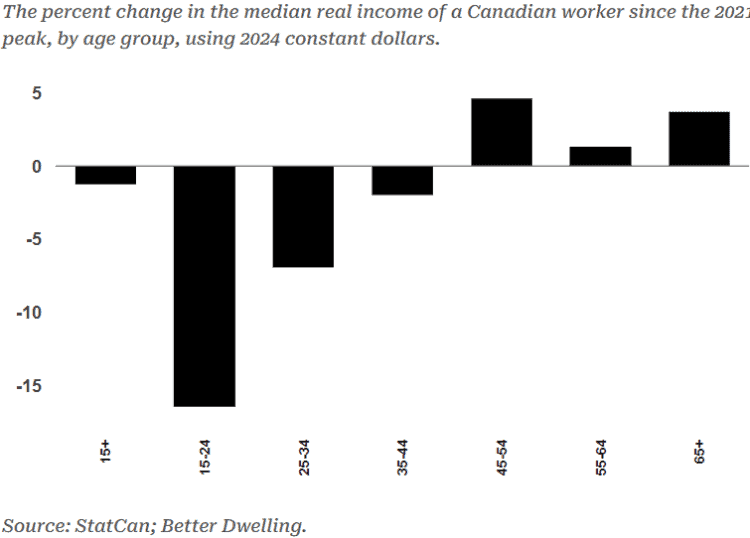
Canadian real income reached a recent peak around 2021 before overall growth began to slow.
Between 2021 and 2024, real income for Canadians aged 15 and older declined by approximately 1.3%.
But younger workers experienced much larger declines.
Real income fell 16.5% for Canadians aged 15 to 24, 6.9% for those aged 25 to 34, and 2.0% for ages 35 to 44.
By comparison, real income increased 4.6% for those aged 45 to 54, 1.3% for ages 55 to 64, and 3.7% for those aged 65 and older.
This means the income adjustment of the past several years has not been shared evenly across Canadians.

The Bigger Shock: Youth Income Peaked in the 1970s
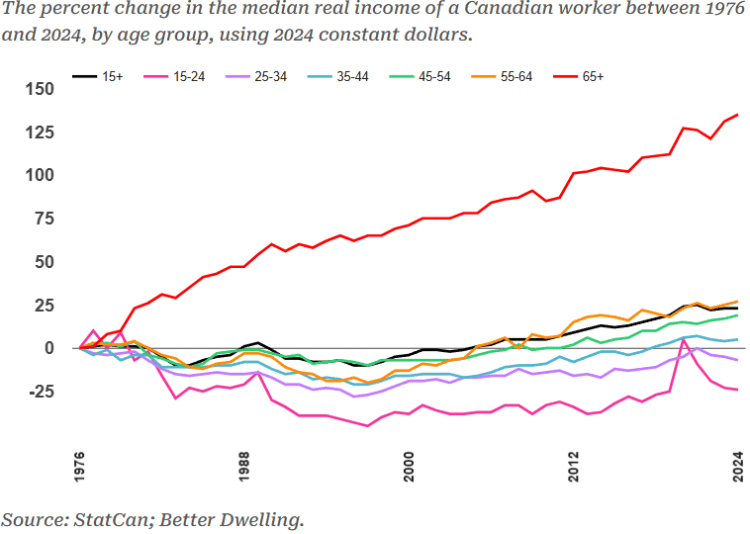
Looking even further back, long-term Statistics Canada data beginning in 1976 reveal an even wider generational divide.
Between 1976 and 2024, real income for Canadians aged 15 and older increased by only about 9.2% in total, equivalent to a compound annual growth rate of approximately 0.18%.
But real income for Canadians aged 15 to 24 fell by 24% over that period, with the income peak for this age group occurring all the way back in 1977.
Canadians aged 25 to 34 have not performed much better. Their real income declined approximately 7% over nearly 48 years, with their peak income dating back to 1976.
At the same time, older age groups have experienced significantly stronger long-term income growth.
Over nearly 48 years, real income increased about 5% for Canadians aged 35 to 44, 19% for ages 45 to 54, 27% for ages 55 to 64, and 135% for those aged 65 and older.
The long-term income paths of younger and older Canadians have clearly diverged.
Income Has Fallen, but the Cost of Living Has Not Returned to 1977
This is one of the biggest pressures facing younger Canadians today.
Young people several decades ago may not have earned high incomes, but housing prices and living costs were also at very different levels. Today, younger Canadians have seen little improvement in real income, with some age groups earning less than they did nearly 50 years ago, while housing and everyday living costs have increased substantially.
That means younger Canadians must face much higher housing barriers and living expenses with comparatively weaker income power.
The consequences are becoming increasingly visible: saving for a down payment takes longer, independent living is more expensive, homeownership is delayed, and the timelines for starting families and building assets are changing.
AiF Insight: Building Wealth Can No Longer Depend Only on Salary
These figures reflect more than simply “young people earning less.”
The nature of employment and income itself is changing. AI, automation and corporate efficiency improvements are redefining many types of work. The traditional path of graduating, finding a job, receiving steady raises and gradually building wealth through salary may not continue in the same way experienced by previous generations.
When wages increasingly struggle to outpace living costs, relying only on employment income can also slow the pace at which households build wealth.
One of the biggest advantages young people have is time. The earlier they begin building financial assets such as stocks and funds, allowing capital itself to participate in long-term growth, the greater the opportunity to gradually reduce dependence on a single source of employment income.