Cost Comparison: Home Advantage Shrinks with Care Needs
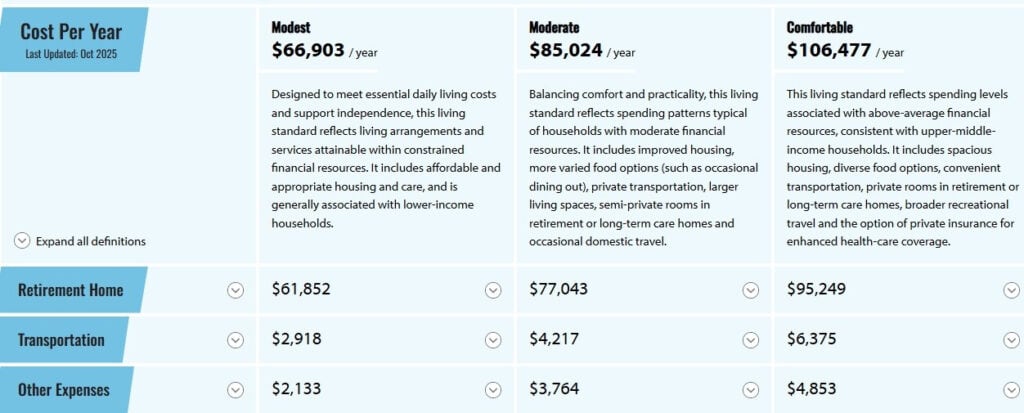
Initial comparisons suggest that aging at home can be more affordable—especially when no external care is required. For example, a retired couple in Toronto living in a fully paid-off home may spend approximately CAD 47,415 per year for a comfortable lifestyle.
By contrast, retirement home costs are significantly higher:
• Comfortable level: about CAD 106,477 per year
• Moderate level: about CAD 85,024 per year
• Basic level: about CAD 66,903 per year
However, the financial picture changes quickly once home care services are introduced. With increasing levels of care, costs rise sharply:
• 5 hours of care per week: about CAD 57,147 per year
• 20 hours per week: about CAD 86,343 per year
• 40 hours per week: about CAD 125,270 per year
At moderate to high care levels, the cost of aging at home in Canada can approach or even exceed that of a retirement facility.
The Real Driver: Care Needs, Not Housing Choice
The key variable in retirement costs is not where someone lives, but how much care they require.
As individuals age, maintaining independence becomes increasingly challenging. Daily activities such as personal hygiene, dressing, eating, mobility, and basic physical control often require assistance over time. While some retirees remain independent in the early years, reliance on external support tends to grow gradually.
Canada’s public healthcare system provides limited home care support, which is often insufficient for long-term or high-frequency needs. As a result, many families must rely on private services, significantly increasing out-of-pocket expenses.
Hidden Costs of Staying at Home
Homeownership itself introduces additional financial and practical burdens. Ongoing responsibilities include seasonal maintenance such as snow removal and yard care, as well as repairs related to plumbing, electrical systems, or structural issues.
Beyond financial costs, these tasks also require time, physical ability, and decision-making capacity. For seniors without nearby family support, these challenges can become significant barriers to staying at home.
In contrast, retirement homes—while more expensive upfront—offer centralized management of daily living, healthcare support, and risk control. This reduces uncertainty and eliminates many of the hidden costs associated with homeownership.
Conclusion
While aging at home remains the preferred option for many Canadians, the cost of aging at home in Canada is often underestimated. As care needs increase, the financial advantage of staying at home can quickly disappear.
For individuals and families, the key is not just choosing where to live, but planning for how care needs—and costs—will evolve over time.