
Korean Retail Investors Hit by Leveraged ETF Losses as Chip-Linked Products Fall More Than 80%
After South Korea relaxed rules for single-stock leveraged ETFs, retail investors poured into products tied to Samsung Electronics and SK Hynix. When chip stocks reversed sharply, some leveraged ETFs collapsed from their highs, leading to heavy losses and a public apology from the finance minister.

After South Korea recently eased rules for single-stock leveraged ETFs, a large number of retail investors rushed into the market, hoping to amplify gains from popular chip stocks such as Samsung Electronics and SK Hynix.
But when the Korean stock market suddenly turned lower and semiconductor shares sold off sharply, those products quickly suffered heavy losses. Some investors were left with severe declines in a very short period of time.
As the situation continued to draw attention, South Korean Finance Minister Koo Yun-cheol publicly apologized at a parliamentary meeting, acknowledging that the launch of single-stock leveraged ETFs had not been carefully considered. Korean financial regulators also said they are studying higher eligibility requirements and may eventually restrict access to professional investors only.
Korean Retail Investors Put In Nearly US$10 Billion
South Korea officially introduced single-stock leveraged ETFs on May 27. These products usually track one stock and aim to multiply that stock’s daily price movement.
According to KB Financial Group, after the products were introduced, Korean retail investors made net purchases of 14 trillion won, or about US$9.7 billion. Foreign investors, by comparison, bought about 2 trillion won on a net basis.
Much of that money flowed into products tied to popular chip stocks. Before the downturn, Samsung Electronics and SK Hynix had been rising on enthusiasm around artificial intelligence investment, helping make Korea’s Kospi one of the strongest-performing markets in the world.
When a market keeps rising, leveraged ETFs can appear extremely attractive. If a regular stock rises 1% in a day, a product designed to deliver two times the daily move could theoretically rise about 2%.
But leverage also magnifies losses.
SK Hynix Leveraged ETF Falls More Than 80% From Its High
As the chip-stock rally reversed, the Korean stock market went through a sharp correction.
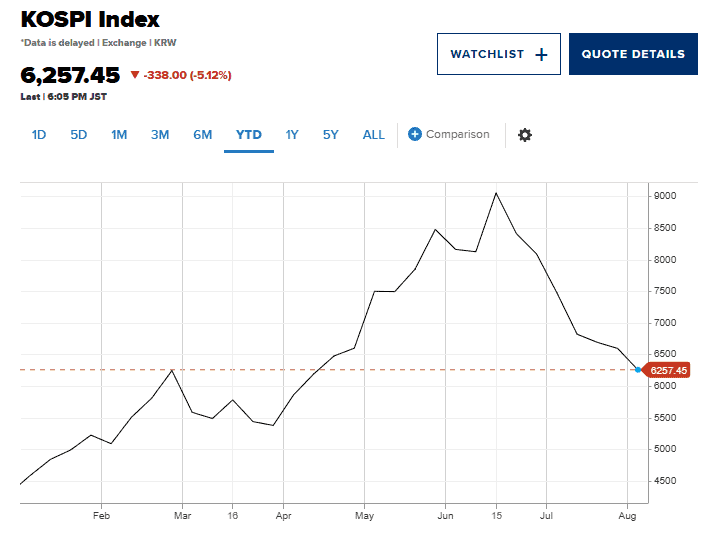
Over the past month, the Kospi index at one point fell close to 35%. The chip sector, previously one of the strongest parts of the market, became a major area of weakness. Retail investors who chased single-stock leveraged ETFs near the top faced even larger losses.
According to LSEG data, the KODEX SK Hynix Single Stock Leverage ETF is designed to provide two times the daily performance of SK Hynix shares. From its June 23 high, the product has fallen more than 80%.
A similar leveraged ETF tied to Samsung Electronics has fallen nearly 75% from its June 3 high.
That means some investors who bought during the hottest phase of the market lost most of their principal in just over a month. Even if the underlying chip stocks recover later, leveraged ETFs may not return to their previous levels in the same way.
Finance Minister Apologizes as Regulators Consider Restrictions
Facing large investor losses, Korean lawmakers demanded an explanation from the government about how these products were made available.
Finance Minister Koo Yun-cheol later apologized publicly during a parliamentary meeting, acknowledging that the launch of single-stock leveraged ETFs lacked sufficient consideration.
Lee Eog-weon, chairman of Korea’s Financial Services Commission, also said regulators are studying further restrictions on these products.
One option under discussion is raising investor eligibility requirements so that single-stock leveraged ETFs may eventually be limited to professional investors. Regulators may also consider reducing the leverage multiple.
Lee said two-times leverage can create excessive volatility. If future legislation allows it, reducing leverage could help ease price swings.
Regulators are also expected to review how rule changes could account for existing investors, including through fund beneficiary meetings and related procedures.
Why Leveraged ETFs Can Fall Faster Than Stocks
Single-stock leveraged ETFs usually target a multiple of one stock’s daily return, not a simple multiple of that stock’s long-term cumulative return.
For example, if a stock falls 10% on the first day and rises 10% on the second day, it does not return to its original price. It is still down about 1%.
For a two-times leveraged product, the first day may bring a 20% decline, followed by a 20% gain on the second day. The ending value would still be about 4% below the starting value.
When markets are volatile, this daily reset mechanism can continuously erode the product’s net asset value. The larger the volatility and the longer the holding period, the more the result can differ from what investors imagine as “two times the stock’s move.”
That is why leveraged ETFs are closer to high-risk short-term trading tools. If retail investors chase them when the market is hottest and do not manage losses quickly, the speed of decline can be much greater than ordinary stocks.
Why Ai Financial Has Always Been Cautious About ETFs
Ai Financial has long maintained a cautious view toward ETFs, especially leveraged ETFs.
ETFs may look attractive because they are easy to trade, often transparent, and may have relatively low costs. But that does not mean all ETFs are suitable for ordinary investors. “ETF” is only a product structure. Inside that structure, a fund may hold broad market indices, single stocks, options, leverage, inverse strategies, or highly concentrated sector exposure.
The presence of the word “ETF” in a product name does not automatically reduce risk.
Single-stock leveraged ETFs are especially complex because they combine single-company risk, sector concentration risk, market volatility risk, and leverage decay. Investors are no longer simply buying the long-term development of Samsung Electronics or SK Hynix. They are using a trading tool that requires constant judgment about short-term direction and volatility.
The large losses suffered by Korean retail investors show that risks ignored during a rising market can quickly surface when direction changes.
Ordinary investors need asset allocation that can be held for the long term, has a clear risk structure, and matches personal goals and risk tolerance. Using leveraged ETFs to make an amplified bet simply because a stock is popular can easily turn long-term investing into short-term speculation.